All Terrain Crane vs Rough Terrain Crane - Key Differences Explained
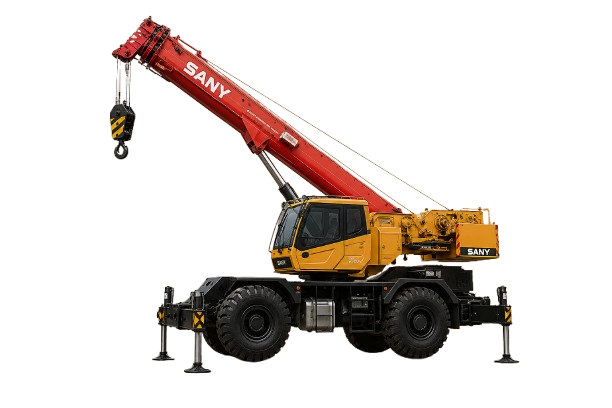
Both all-terrain (AT) cranes and rough-terrain (RT) cranes are mobile cranes built for challenging conditions - but they are designed for fundamentally different scenarios. Picking the wrong type can result in a crane that cannot reach your site legally, cannot achieve the required lift radius, or costs far more than the job demands. Here is a clear, side-by-side breakdown to guide your decision.
Road Travel
All Terrain Crane
Highway legal. Multi-axle design allows self-propelled travel at road speed between sites across India.
Rough Terrain Crane
Not road legal. Must be transported to site on a lowboy trailer - adds transport cost and planning time.
Verdict
Need to move between multiple sites or travel interstate? All terrain is the only option.
Capacity Range
All Terrain Crane
50T to 1,200T+. Covers the full range from medium industrial lifts to mega infrastructure projects.
Rough Terrain Crane
25T to 130T. Suitable for medium-weight structural, mechanical and construction lifts.
Verdict
Very heavy lifts above 130T → all terrain only. Mid-range lifts on confined off-road sites → rough terrain.
Ground Pressure
All Terrain Crane
Requires solid, prepared ground. High point loads on outrigger pads need good bearing capacity.
Rough Terrain Crane
Large, wide tyres distribute load more evenly. Lower effective ground pressure handles soft or unprepared ground better.
Verdict
Soft, muddy or unprepared sites → rough terrain. Hard-standing or road-adjacent → all terrain.
Setup Time
All Terrain Crane
Both types use outrigger pads. Larger all-terrain cranes (200T+) have more complex counterweight and boom assembly.
Rough Terrain Crane
Simpler setup for most RT models. Faster to get operational on smaller lifts.
Verdict
For fast-turnaround single lifts on confined sites, rough terrain is often quicker to set up.
Day Rate Cost
All Terrain Crane
Higher day rate reflecting larger machine, greater capacity and more complex logistics.
Rough Terrain Crane
Lower day rate. More economical for confined off-road sites where road travel is not needed.
Verdict
Confined off-road sites on a tighter budget → rough terrain. Complex multi-site projects → all terrain.
Typical Projects
All Terrain Crane
Bridge construction, power plant and wind turbine erection, heavy industrial installations, port infrastructure.
Rough Terrain Crane
MIDC construction site yards, industrial zone mechanical erection, off-road building sites, infrastructure within a single confined area.
Verdict
Project type is often the deciding factor - match the crane to the site conditions, not just the capacity.
When Saini Lifters Recommends Each Type
For pan-India deployment - interstate infrastructure projects, bridge construction, power plant erection - Saini Lifters' XCMG all-terrain cranes (160T–300T) are the right choice. They travel under their own power, set up quickly and offer industry-leading lift capacities at height.
For local MIDC zone projects, construction site yards in Navi Mumbai and Panvel, and off-road heavy lifts where road travel is not required, a rough-terrain crane offers lower cost and superior ground handling. Talk to Saini Lifters about your site conditions and we will recommend the right crane for your specific job.
Need a Mobile Crane in Navi Mumbai?
Saini Lifters Crane Service has provided all-terrain and mobile cranes for construction, infrastructure and industrial projects since 2001. Call us for a free consultation and quote.